

Vinted Moderation & AI Photos: allowed or grey area? 🔍
Is it against the rules to use AI photos? Could your listing be removed? Can you mix real and AI photos? We read the catalog rules, the terms & conditions and the EU AI Act for you.
A Vinted seller since 2019 with 850+ sales. She breaks down how the platform works to help the community sell with peace of mind.
Vendy Studio editorial persona (fictional byline)
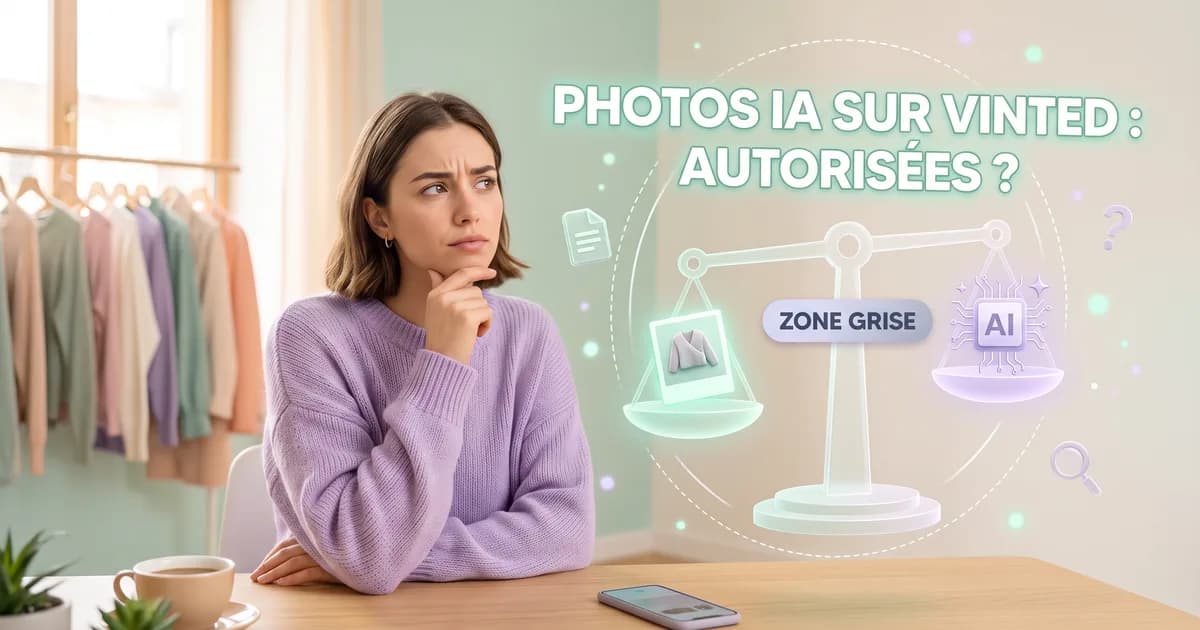
In this guide
You've just generated a clean AI worn photo for your Zara dress. The listing is ready… and right before you hit "Upload", the doubt creeps in: "Wait. Am I actually allowed to do this?"
You're not the only one asking. On forums and in seller groups, it's THE hot topic. And the answers you'll find range from "no problem at all" to "you'll get banned" — usually without a single source.
So we did the work properly: we read Vinted's catalog rules, the terms & conditions, the EU AI regulation and the legal analyses published on the subject. In this article, we answer the 3 questions everyone is asking:
- Is it against Vinted's rules to use AI photos?
- Could my listing be removed if I use AI photos?
- Can I mix real photos and AI photos?
Full transparency before we start
We are neither Vinted nor a law firm. VendyStudio is an independent tool with no connection to the platforms mentioned in this article. What follows is our reading of the public rules (catalog rules, terms & conditions, AI Act), with sources and consultation dates. The final interpretation of its rules belongs to each platform — and to it alone.
0
mentions of the word "AI" in Vinted's catalog rules (as of 2 July 2026)
20
photos maximum per listing according to the catalog rules
2 Aug 2026
EU AI Act transparency obligations (art. 50) become applicable
Want pro visuals
faithful to your items? 🎁
VendyStudio generates AI worn photos from the real photo of your garment, for your Vinted, Depop, Beebs listings. 3 free credits on sign-up, no credit card needed.
Is It Against Vinted's Rules to Use AI Photos?
Short answer: the rules say neither yes nor no. The word "AI" simply doesn't appear in Vinted's catalog rules (consulted on 2 July 2026). But that doesn't mean anything goes — far from it.
What the catalog rules say, word for word
Vinted's catalog rules set very clear requirements for listing photos:
- "They have to be taken by you with the purpose of using the photos on Vinted";
- "They cannot be replaced with stock photos, photos from ads and watermarked images";
- "They have to represent the item as it is - no image editing is allowed";
- "The first photo should clearly represent the whole item";
- "We also recommend showing any defects, scratches, wear, etc.".
You'll notice the same thing we did: not a word about artificial intelligence. These rules were visibly written to fight stolen photos and misleading listings — not to settle the question of generated visuals.
The grey area: between 'taken by you' and 'as it is'
This is where it gets interesting. Is an AI visual generated from the real photo of your item a photo "taken by you"? Is a faithful AI staging a prohibited "edit" or simply presentation? The texts don't say.
French law firm HAAS Avocats, which analysed the subject in October 2025 (article in French), reports that Vinted would consider AI used as a "simple enhancement tool" as not prohibited, as long as the practice respects the terms and conditions and doesn't misrepresent the product's real condition. That's a reading reported by a third party, not an official commitment from the platform — but it draws the guiding line: what matters is faithfulness to the real item.
- Stock photos, photos from ads and watermarked images
- Editing that changes the real appearance of the item
- A photo that hides defects (stains, snags, wear)
- A visual that doesn't represent the item "as it is"
- Photos borrowed from other listings or websites
- Photos "taken by you" for your listing
- The item represented "as it is"
- A first photo that clearly shows the whole item
- Defects, scratches and signs of wear shown (recommended)
- Sharp, clear photos
Nobody speaks for Vinted (including us)
Only the platform decides how to interpret its own rules, listing by listing. And those rules can change without notice. What's tolerated today may not be tomorrow — which is why you should re-read the current texts before publishing.
Before even talking about AI, make sure you've mastered the basic photo rules that actually sell: whole item on the first photo, sharpness, light, defects shown. That's the foundation — AI or not.
Could My Listing Be Removed If I Use AI Photos?
Honest answer: yes, it's possible — as with any photo deemed non-compliant with the rules. But the public observations make it clearer what moderation targets first.
What we can observe about moderation
Vinted's moderation is opaque: the platform doesn't publish its detailed criteria, and nobody outside knows exactly how listings are filtered. What is publicly documented is that the platform "removes certain listings or blocks manifestly fraudulent accounts" (HAAS Avocats, October 2025). Asked about the rise of generated visuals, Vinted told the press it was "closely monitoring AI-related developments in its members' practices" (intelligence-artificielle.com, August 2025).
In other words, as we write this: no general ban announced, no documented systematic crackdown — but a platform that is watching, and that keeps every right its terms give it, including removing a listing or restricting an account for violating its rules.

The real risk factors
Cross-referencing the catalog rules and the published analyses, the risk seems to lie less in the tool you use than in the published result. What exposes your listing:
- A visual that doesn't represent your real item (altered colour, different cut, idealised fabric);
- Airbrushed defects: the stain or snag the buyer will discover on delivery;
- A photo that looks like a catalogue or stock image — explicitly ruled out by the rules;
- An item that is non-existent or different from what the visual shows: that's no longer a grey area, that's fraud.
No guarantee, ever
Platforms' moderation systems are opaque and constantly evolving. No tool — VendyStudio included — can guarantee your photos will be accepted. You remain responsible for what you publish: that's true on Vinted, Depop, Leboncoin and everywhere else.
And keep in mind that removal isn't the only risk: an unengaging listing can also simply get buried. We explain how the algorithm decides your listings' visibility in our dedicated deep dive.
AI visuals
designed to respect your item ✨
VendyStudio generates a worn photo from the real photo of YOUR garment, designed to respect its colour, cut and condition. You check the render before you publish — 3 free photos to try.
Can I Mix Real Photos and AI Photos on Vinted?
The public rules don't address this specific case. But it's actually the most interesting scenario, because it aims to reconcile what the rules require (the real item, as it is) with what makes buyers click (a clean, professional worn render) — without prejudging the platform's interpretation.
The prudent approach often shared in the community
The idea is simple: real photos remain the backbone of the listing; the AI visual comes as a complement.
Concretely: your first photo shows your real item, in full — an explicit requirement of the catalog rules. Your next photos document the real condition, defects included. And your AI visual (for example a worn photo on a virtual model) enriches the listing by showing the drape and the fit, without ever pretending to replace the real item.
The prudent mix: real photos + AI visual
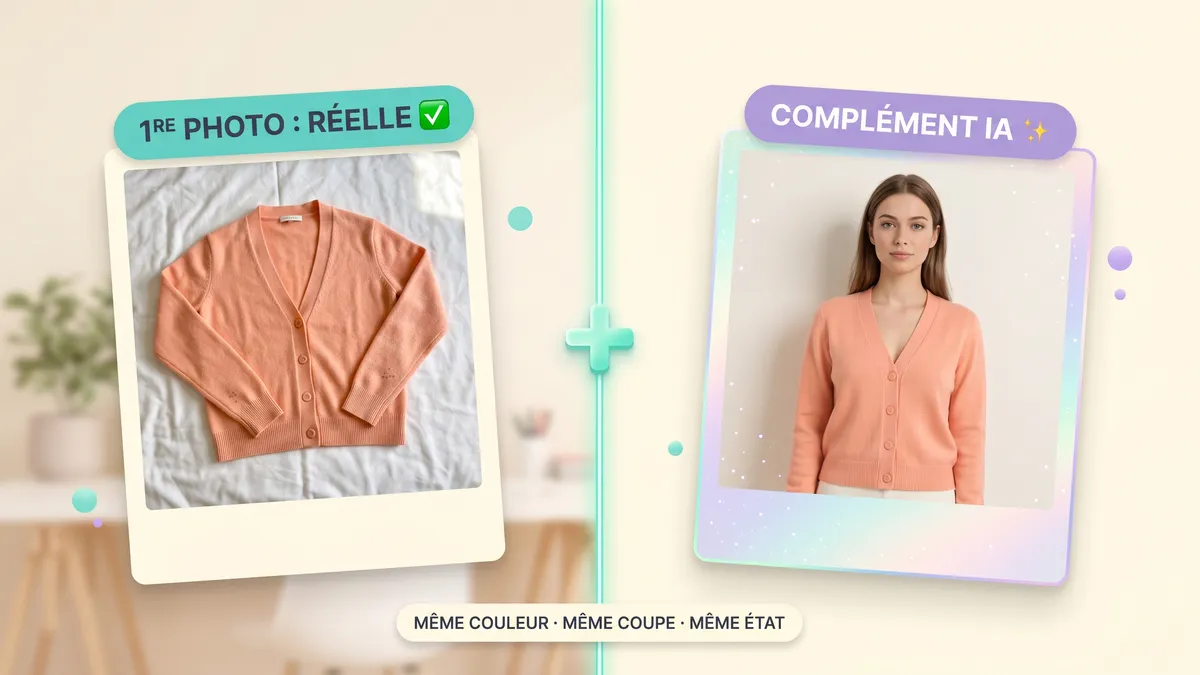
This mix has another huge advantage: you no longer need to pose yourself to show the worn look. We detail this approach in our article on AI-generated worn photos — from flat lay to model render in 30 seconds.
What about other platforms?
Depop, Leboncoin, Beebs, Vestiaire Collective… each platform has its own publication rules and its own moderation. What's tolerated on one may be refused on another. The reflex is the same everywhere: read the rules of the platform concerned before publishing.
Transparency and the AI Act: What EU Law Says
Beyond Vinted's rules, there is now a European framework. Regulation (EU) 2024/1689, known as the "AI Act", sets out transparency obligations for AI-generated or manipulated content in its Article 50.
According to the text of the regulation:
- Providers of generative AI systems must ensure that outputs are marked in a machine-readable format as artificially generated or manipulated;
- Deployers (which can include professional users of these systems) must disclose that image, audio or video content has been artificially generated or manipulated, with exceptions (artistic uses, standard editing functions…);
- These obligations become applicable on 2 August 2026 — that's one month from the moment we're publishing this article.
HAAS Avocats also notes that the only measure reportedly considered by Vinted at this stage would be adding an explicit "AI-generated image" label on the listings concerned. Nothing officially rolled out as we write — but the direction is clear: transparency is becoming the norm.

In practice, the good habit to adopt right now: a note like "AI-generated visual" in your description. It's free, it takes ten seconds, it's aligned with the spirit of the law — and it can build trust with your buyers instead of breaking it.
This is not legal advice
We're relaying what the text of the regulation says, with a link to the official source. How the AI Act applies to your specific situation (status, sales volume, professional use or not) is a matter for a legal professional. When in doubt, consult one.
The Checklist to Use AI with Peace of Mind
Let's recap everything we've seen in one actionable checklist. The common thread, as you've gathered: faithfulness to the real item + transparency. That's what emerges from the catalog rules, the legal analyses and the AI Act alike.
The peace-of-mind checklist before publishing
If you tick every box, you've done what's reasonably in your power. The rest — the final interpretation — belongs to each platform, and that's true for every seller, AI photos or not.
Sources & References
- Vinted — Catalog Rules, consulted on 2 July 2026
- Vinted — Terms and Conditions, consulted on 2 July 2026
- European Union — Regulation (EU) 2024/1689, the "AI Act", Article 50 (transparency obligations), applicable from 2 August 2026
- HAAS Avocats, 16 October 2025 — AI abuses on Vinted: doctored photos and scams (in French)
- Intelligence-artificielle.com, 7 August 2025 — Vinted and AI-generated images (in French; Vinted statement: "closely monitoring AI-related developments")
Quotes from Vinted's rules reflect the version consulted on the date indicated; the platform can modify these texts at any time.
Conclusion: Grey Area Doesn't Mean Wild West
Let's sum up the 3 answers, no corporate hedging:
- Against the rules? The catalog rules don't explicitly ban AI photos — but they require photos faithful to the real item, taken by you, with no misleading editing. It's a grey area, and the interpretation belongs to Vinted.
- Risk of removal? Possible, as with any non-compliant photo. What moderation demonstrably targets is deception — not the tool. A faithful visual can limit the risk; no tool can eliminate it.
- Mixing real and AI photos? It's the most prudent approach: a real first photo of the whole item, documented defects, the AI visual as a complement and a transparency note.
Photos are still what sells. AI can help you make them professional — as long as you stay faithful to your item and transparent with your buyers. The choice, as always, is yours.
FAQ: AI Photos & Vinted Moderation
Learn More 📚

How to take Vinted photos
White background, natural light, AI mannequin or worn shot: all 2026 techniques for Vinted photos that sell fast. Before/after examples included.
Read the article
Why I'm No Longer Selling on Vinted?
Shadowban? Unexplained drop in views? Discover the REAL Vinted algorithm criteria and top sellers' hacks to boost your visibility.
Read the article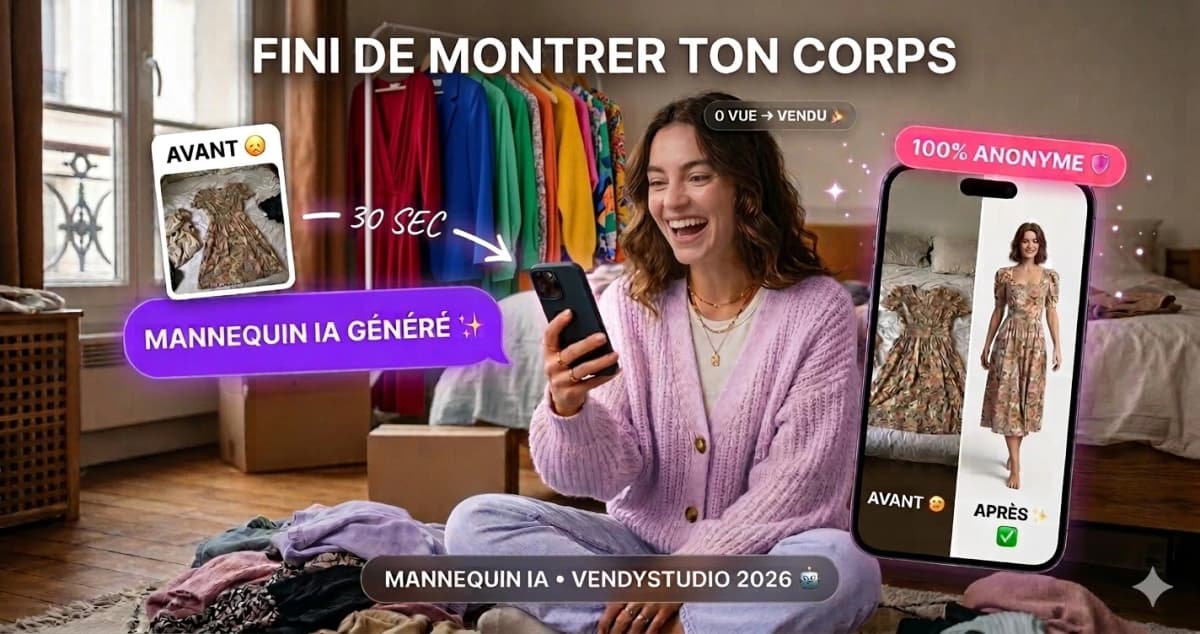
Vinted Modelled Photos by AI:
I tested generalist AIs for my Vinted photos. Straight verdict, a 5-minute method and a secure alternative. 2026 guide by the VendyStudio team.
Read the article
Vinted Security ALERT:
AI tools can transform your Vinted photos. Sell while preserving anonymity: virtual model, custom background, privacy configuration.
Read the articleSophie Mercier
Experienced Vinted Seller
A Vinted seller since 2019 with 850+ sales. She breaks down how the platform works to help the community sell with peace of mind.
Vendy Studio editorial persona (fictional byline)
⚖️ Legal Information & Transparency
Independence: VendyStudio is an independent service. We are not affiliated with Vinted, Beebs, Depop or any other resale platform mentioned in this article.
Results: Performance figures mentioned are based on user feedback and internal research (January 2026). Results may vary.
Responsibility: Always check your platform's terms and conditions before publishing. You are responsible for the content you publish.
Moderation: Platform moderation systems are opaque and may change. VendyStudio cannot guarantee that your photos will be accepted by moderators.
This article is informational: it reflects our reading of Vinted's public rules as of 2 July 2026 (catalog rules and terms & conditions, links at the end of the article). It is neither legal advice nor an official position of Vinted. VendyStudio is an independent service with no connection to Vinted or any other platform mentioned. Rules and moderation can change without notice: always check the current texts before publishing — you remain solely responsible for your listings.
Ready to create pro visuals,
with your eyes open? 🚀
VendyStudio generates AI worn photos from your real item, for your resale listings (Vinted, Depop, Beebs). A render in 30 seconds, built to stay faithful to your item — and you stay in control of what you publish.