

Listing photos and deepfakes: limit your exposure
In early 2026, the Grok affair was a reminder that a public photo of a real person can be altered by AI. Here is how to reduce what you expose when selling online.
Founder of Vendy Studio, which he builds from northern France. He designs the tool, tests the AI models and digs through the rules — tax and platform — that frame online reselling.
In this guide
Updated 22 October 2026
In early 2026, the Grok affair was a reminder that a public photo of a real person can be altered by AI without their consent.
Do you sell online and sometimes model your clothes to show them off? This guide sums up what the press reported about the Grok affair, then the simple steps to publish fewer photos of yourself and use AI transparently with your buyers.
The Grok affair: what the press reported
In late 2025 and early 2026, users of X (formerly Twitter) asked Grok, the AI built into the social network, to alter photos of real people to show them undressed, often with the prompt "put her in a bikini".
According to an analysis by the NGO AI Forensics reported by franceinfo, in a sample of 20,000 images generated by Grok between 25 December and 1 January, more than half of the people depicted were scantily dressed or undressed.
According to L'Obs, the feature was first partly disabled for non-subscribers (9 January 2026). According to Le Monde, X then restricted, on 15 January 2026, Grok's generation of nude images of real people.
These images targeted photos posted on social networks. Nothing in these articles points to any particular resale platform: the lesson applies to any photo of you available online.
Why a public photo can be misused
Image generation tools can now modify an existing photo ("image-to-image"). A public photo can be saved by anyone and then submitted to this kind of tool.
Key point
The more photos of you there are online, and the more recognisable you are in them (face, distinctive tattoo, your home in the background), the more possible a misuse becomes, and the more it identifies you. Publishing fewer photos of yourself reduces this risk, without removing it.
Limit your exposure
A few habits to keep selling while showing less of yourself:
Good habits
Crop out your face: if you model an item, a neck-to-knee shot is often enough.
Show the item alone: flat lay, on a hanger or on a dress form. It's also what buyers look at first.
Don't post photos of your children: children's clothes look great laid flat.
Watch the background: avoid anything that could locate you (window view, address, visible post).
Virtual models, used transparently
AI can also give an idea of the worn look without you appearing in the photo. That is how Vendy Studio works:
- You photograph the item alone, flat or on a hanger. The Terms only allow photos with no identifiable person.
- The AI generates a virtual model wearing the item: it is neither you nor a real person.
- Your photos are deleted automatically after a limited period, set out in the Terms.
On Vinted: an AI photo complements, it doesn't replace
Vinted's catalogue rules ask for photos of the actual item being sold. So keep at least one real photo of the item, never change its colour, cut or flaws in the AI visual, and flag it: on vinted.fr, Vinted now offers an option to mark photos as AI-generated when listing (observed on 21 October 2026; it may vary by country and app version). A note in the description ("worn visual generated by AI") removes any ambiguity. Details in our article on Vinted's AI option.
A worn look without showing yourself
Photograph the item alone, the AI generates a virtual model. Add it to your real photos and flag the AI.
Try Vendy StudioLingerie and swimwear
Photos of yourself in underwear or swimwear are the most sensitive if misused. For these items, it is better not to model them yourself.
Lingerie and swimwear: what a virtual model allows
If an image of you is misused
- Keep evidence: screenshots showing the page address and date.
- Report the content to the platform hosting it.
- File a complaint with the police. In France, the Criminal Code punishes sharing, without consent, a manipulated or AI-generated image of a person (article 226-8), with heavier penalties when it is sexual (article 226-8-1); many other countries have similar laws.
- Get support: many countries have a helpline for victims of online image abuse.
In short
Publishing fewer photos of yourself is the simplest precaution. To show a worn look, a virtual model can complement your real photos, as long as you stay transparent with buyers.
Checklist
Check your listings
Sources
- Le Monde: X restricts Grok on generating nude images (15/01/2026, in French)
- franceinfo: one in two images generated by Grok showed undressed people, according to AI Forensics (in French)
- L'Obs: Grok partly disables its tool (09/01/2026, in French)
- Vinted catalogue rules (French version)
- French Criminal Code, articles 226-8 and 226-8-1 (Légifrance)
- vinted.fr interface: option to mark photos as AI-generated (observed on 21 October 2026)
FAQ: listing photos and deepfakes
Related Articles
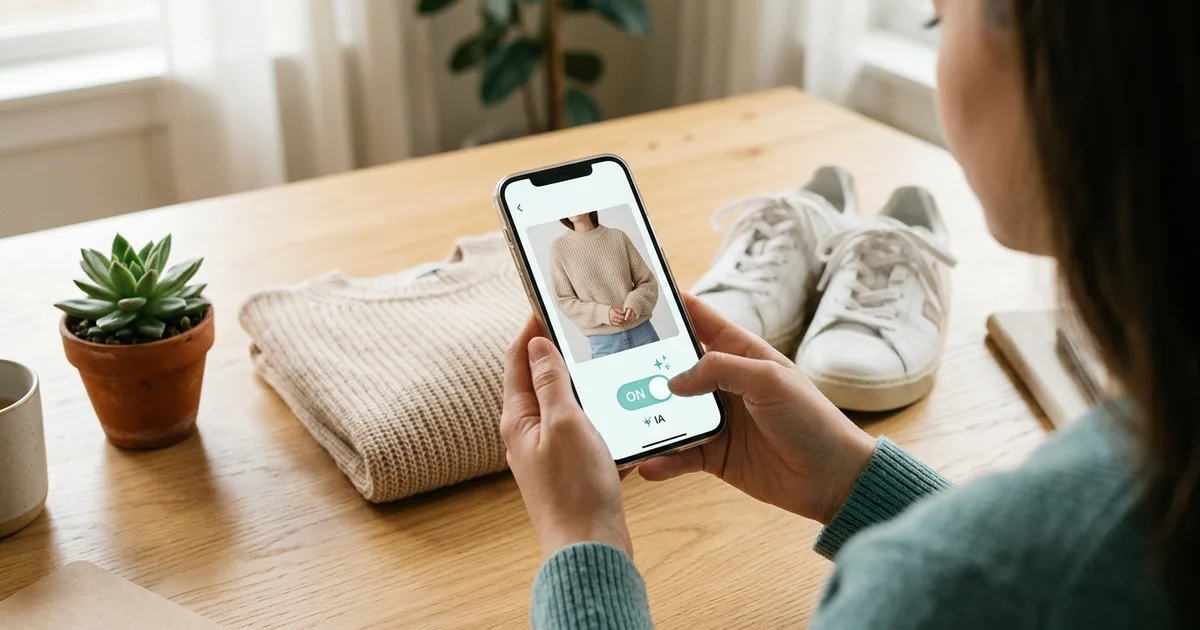
Vinted AI: the toggle is here,
Vinted now shows a toggle to flag AI use when you upload photos. What it means for AI photos on Vinted, what's still banned, and how to use it well.
Read the article
Vinted Scams 2026:
Buyer & seller protection. Discover the most common scams, our security checklist and how to protect yourself effectively on Vinted.
Read the articleHow to take Vinted photos
White background, natural light, AI mannequin or worn shot: all 2026 techniques for Vinted photos that sell fast. Before/after examples included.
Read the article⚖️ Disclaimer & Transparency
Independence: VendyStudio is an independent service. We are not affiliated with Vinted, Beebs, Depop or any other resale platform mentioned in this article.
Responsibility: Always check your platform's terms and conditions before publishing. You are responsible for the content you publish.
This article is for information only. Facts about the Grok affair come from the press articles listed at the end (Le Monde, franceinfo, L'Obs). It is not legal advice: for a specific situation, contact a solicitor or the authorities. Vendy Studio is an independent service with no link to Vinted, X or xAI. A virtual model reduces the number of photos of you online; it does not protect against every misuse of images already published. You remain responsible for your listings and for each platform's rules.
Present your clothes without exposing yourself
An AI-generated worn look, alongside your real photos.