

The AI Scam Draining Vinted Accounts And How to Never Fall Victim to It Again 🛡️
Scammers are using artificial intelligence to fake photos and steal money and items from sellers. Here's how it works — and how to protect yourself.
Vendeuse Vinted depuis 2019, +800 ventes. J'utilise VendyStudio pour mes photos.
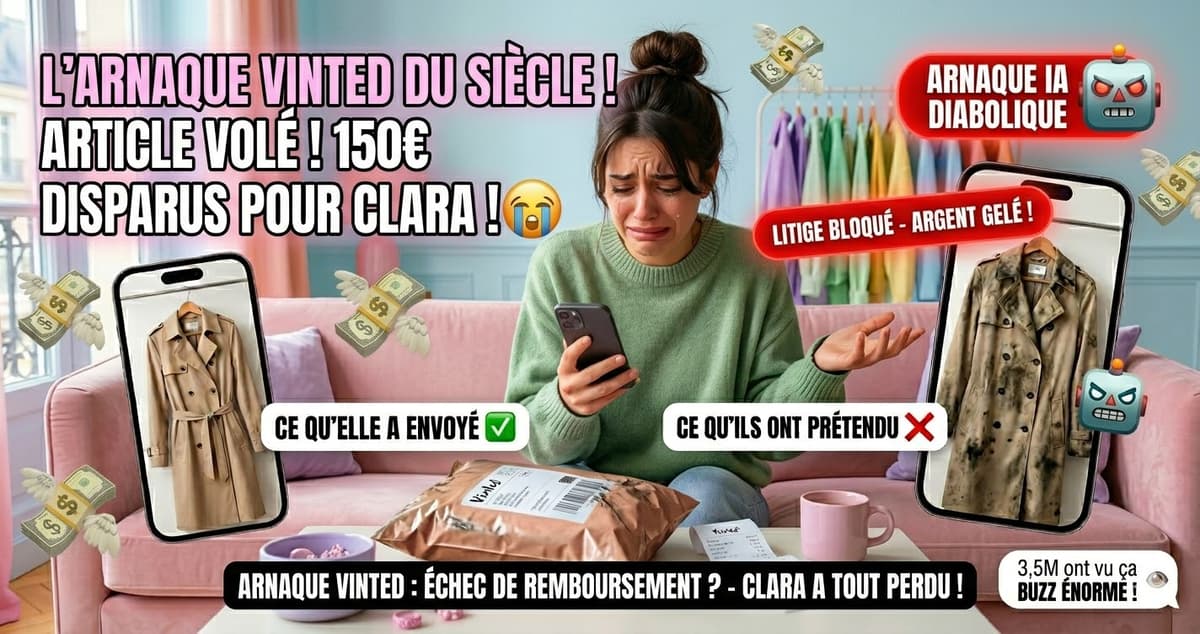
In this guide
On 1 March 2026, @Paingout posted a thread on X. Within 48 hours, 2.2 million people had read it. And the Vinted community would never be the same again.
He had sold his rare copy of the book "The Witches' Kitchen". A valuable item, well packaged, shipped with care. A few days later: dispute notification. The buyer sent photos of the book... cover torn, pages soaked with liquid. A disaster. (Source: thread @Paingout, X, 01/03/2026)
Except that book had never been touched.
Those photos had been fabricated entirely by artificial intelligence. Faced with the "evidence" provided, the platform proceeded to refund the buyer without requiring a return. The seller lost everything: his book and his money.
This is the "AI Refund" scam. It has been ravaging Vinted accounts since March 2026, and if you have an active profile right now, you are a potential target.
The good news? You can protect yourself. And even turn that technology to your advantage. That's exactly what we're going to explore together.
2.2M
views in 48 hours
Thread @Paingout on X (01/03/2026)
100%
lost without recourse
Item + money for victims
5 years
prison sentence risked
Art. 313-1 Penal Code — Fraud
What exactly is the AI Refund scam? 🚨
A malicious buyer receives your item in perfect condition. They take real photos. Then they use an AI tool (inpainting technique) to digitally add damage — tears, stains, mould — to their photo. They submit these false proofs to Vinted support. Result: full refund without returning the item. They keep your object AND get their money back.
Seller on Vinted?
Protect your profile now.
A professional profile inspires confidence and tends to discourage opportunistic profiles before they even click. Try VendyStudio for free.
The Anatomy of the Scam: 6 Steps Decoded
The "AI Refund" scam is not improvised. It's a well-oiled mechanism that unfolds like a perfectly planned heist. Here's how it works, without the jargon.
Step 1 — Targeting: they don't attack just anyone
Imagine a burglar. They don't target houses with a visible alarm and a barking dog. They target the house that looks easy.
On Vinted, scammers do the same: they spot high-value items (rare books, limited-edition trainers, designer bags) sold by profiles that look amateur — no packaging video, blurry or hastily taken photos.
Step 2 — Receipt and the "mirror photo shoot"
The buyer receives your item in perfect condition. They photograph it in their living room, on their coffee table, with real natural light. This is crucial: the background must be authentic. At this stage, the photo is 100% real. No manipulation. It's the calm before the storm.
Step 3 — Digital injection (where AI comes in)
Here's the masterstroke. The scammer uses an AI tool called "inpainting" — a technology that lets you select an area of a photo and modify it. It's the same tech that graphic designers use to erase an unwanted object. Except here, instead of erasing, they add: a tear, a moisture stain, a burn.
And the result is stunning, because the AI recalculates shadows, textures, light... to make it look perfectly real. It's like having an ultra-powerful Photoshop without any technical skills. You type "add a tear to the book cover" and in 10 seconds, it's done. Convincing. Terrifying.
Step 4 — The "damaged parcel" simulation
To convince Vinted it's your fault, the scammer also fabricates proof of the shipping box. They take a photo of your parcel as received and use AI to add a hole, rip marks, broken tape. Message to support: "The item arrived like this, look at the box."
Step 5 — Strategic dispute opening
The buyer clicks on "I have a problem". They attach their fake evidence. In the chat with support, they play outrage: "It was a gift for my daughter, I'm devastated, look at the condition!" They refuse any negotiation. The tone is calculated to trigger a rapid refund.
Step 6 — The jackpot
The Vinted bot — or an overworked human agent — sees damning "proof". Fateful message: "We have processed the refund. Since the item is damaged, you do not need to return it."
The scammer now has your item and your money. And a few days later? They relist your article on another account, with the real photos.
- "Item received completely damaged"
- "The parcel was torn"
- "I am completely in good faith"
- "I demand an immediate refund"
- The item arrived in perfect condition
- The damage was added by AI
- Photos manipulated via inpainting
- The object will be resold on another account
Why Vinted Falls into the Trap (And It's Not That Surprising)
You're probably wondering: "How does a company worth billions get fooled by modified pixels?"
The answer comes down to one word: volume.
Vinted processes millions of transactions every day. Physically, it's impossible to analyse every dispute photo with the eye of a digital forensics expert. Algorithms sort, classify, and decide — often automatically.
And those algorithms were designed to detect "classic" fraud: counterfeits, banned items, harassment. Not to spot artefacts left behind by a generative AI. It's like using a radar meant for detecting aircraft to detect a fly.
The structural bias of buyer protection
Vinted assumes that a buyer providing photos of a damaged item is acting in good faith. It makes sense in 99% of cases. But it's that same logic that scammers exploit. The "Buyer Protection" is a valuable tool — except when hijacked by those who know its flaws.
And since March 2026, methods are spreading at lightning speed through private Telegram groups. Tutorials are being exchanged, "packs" of AI prompts are circulating. The saturation effect is such that Vinted support, drowning in disputes, validates some refunds without thorough analysis.
It's chaos. And you, as an honest seller, find yourself on the front line.
The 10 Signs a Photo Has Been Manipulated by AI
Even the best AIs leave traces. "Glitches" in the matrix, small inconsistencies that the human eye can spot if you know what to look for. Here's your detective checklist.
The warning signs to look for
The Vinted Detective's Trick
On smartphone, long-press the suspicious photo → "Inspect image" in Chrome, or use a free online EXIF analysis tool. The complete absence of information about the camera is already a very strong signal.
You Are a Victim? Here's Your Countermeasure Plan
First absolute rule: don't respond in anger. I know, it's hard. But your response needs to be cold, precise, and scary to moderation algorithms. Here's how to go from victim to fighter.
Arguments that hit the mark
Forget "It's fake!". Here are the phrasings that show you know what you're talking about — and that force Vinted out of its automatic mode.
Information, not legal advice
These phrasings are provided for purely informational purposes, based on public legal texts. For any complex situation or if the dispute persists, consult a legal professional or contact cybermalveillance.gouv.fr for guidance suited to your situation.
Formulas to adapt in your dispute
To challenge the authenticity of the evidence:
"I formally contest the veracity of the photos provided by the buyer. Upon analysis, these images present characteristic artefacts of artificial intelligence generation: lighting incoherence in the degraded area, texture distortion and absence of a realistic drop shadow."To remind them of the law:
"I remind you that the use of fraudulent schemes to obtain an undue advantage constitutes fraud under Article 313-1 of the Penal Code, punishable by 5 years imprisonment and €375,000 fine."To show your evidence:
"The item was shipped in perfect condition, as evidenced by my listing photos and my packaging video. I am ready to file a complaint on cybermalveillance.gouv.fr."The evidence file to build
🔍 Side-by-side comparison — Take your shipping photo and the buyer's photo. Put them side by side. Circle in red the areas where the AI "overflowed". A picture is worth a thousand words.
⚖️ Weight certificate — If the buyer claims the item is "soaked" or "destroyed", the weight of the parcel on return must be identical to the weight at departure. Any variation proves manipulation.
🚨 The threat of filing on cybermalveillance.gouv.fr — Explicitly mentioning this official government website often changes the tone of exchanges. It shows you know your rights and won't back down.
Legal recourse and reporting
If the dispute persists or exceeds a significant amount:
- Report on cybermalveillance.gouv.fr (the French Government's official website for digital fraud)
- File an online pre-complaint on pre-plainte-en-ligne.gouv.fr
- Report on Pharos: internet-signalement.gouv.fr
- Report fraudulent SMS to 33700 (French national anti-spam SMS service)
- Contact Vinted support: support@vinted.fr
- Report the profile directly on Vinted (profile → menu → "Report member")
Prevention is better than cure
— the real anti-scam shield.
A professional VendyStudio profile tends to discourage opportunistic profiles before they even click. Try it free.
5 Tricks to Never Be a Target Again
Trick 1 — The packaging video (your life insurance)
This is your best protection, period. Film yourself showing the item from all angles, place it in the parcel, seal it with tape, stick the label. All in one continuous shot, without cuts.
If a scammer generates an AI image of a torn box, your video will prove that the shipment was flawless. Game over for them.
Trick 2 — "Signature" tape
Use adhesive tape with a complex pattern or your username written on it. Generative AIs struggle to reproduce repetitive text patterns and distorted shapes on cardboard. If the scammer tries to modify the parcel photo, the tape pattern will "melt" — and it will be immediately obvious.
Trick 3 — The scale photo
Take a photo of your finished parcel on a kitchen scale before heading to the post office. The exact weight down to the gram is a physical fact that AI cannot fake in the real world. In case of a dispute, it's solid evidence.
Trick 4 — Invisible marking (for your valuable items)
For your precious pieces, make a small discreet mark with a UV pen — invisible to the naked eye, visible under blue light. In case of a dispute, ask the buyer to photograph the item under UV light. If they've kept the item and used AI for the damage, they won't be able to simulate your secret mark in the right place.
Trick 5 — A strong visual identity (the VendyStudio shield)
Here's what most sellers don't realise: scammers target profiles that look amateur.
Why? Because they're easier to manipulate. A photo taken hastily on an unmade bed, ugly background and poor lighting, gets easily faked by AI without raising eyebrows. But an item presented with a clean studio background and consistent styling? The scammer knows that the seller is organised, that they know how to fight back. It's the same logic as a burglar: they prefer the house without a visible alarm.
Why the professional profile deters opportunists
With VendyStudio, you turn every listing into a mini-lookbook. Consistent background across your whole wardrobe, an ultra-realistic virtual mannequin wearing your real clothing. Result? Your Vinted profile looks like a serious shop. And scammers avoid shops. It's a psychological barrier you put up without even realising it.
| Visual strategy | Buyer perception | Dispute risk | Performance |
|---|---|---|---|
| 📸 Photo on unmade bed | Amateur, easy to manipulate | High 🎯 | Low, many questions |
| 🤳 Selfie / photo worn | Risk of harassment | Medium | Fair but not professional |
| ✨ AI Mannequin (VendyStudio) | Professional, serious shop | Very low 🛡️ | Best appeal, fewer negotiations |
AI Is a Weapon... Or Your Best Ally?
We've just seen the dark side of the force. People using AI to steal, lie, destroy.
But here's what's fascinating: exactly the same technology can be used the other way around.
While some exhaust themselves generating fake tears to steal a few euros, smart sellers use AI to build something entirely different: a shop that inspires confidence and sells.
That's exactly what VendyStudio does. You take a flat-lay photo of your garment — on your bed, on your table, doesn't matter. The AI does the rest: an ultra-realistic virtual mannequin wearing your real garment, a clean and consistent studio background. Result? A presentation that makes people want to buy. And above all, one that shows you're a serious seller, not an easy target.
VendyStudio's philosophy in one sentence
The scammer uses AI to destroy. You can use it to create. While they waste time fabricating fake evidence, you're building a thriving shop. That's turning technology to your advantage.
Conclusion: Reclaim power over your wardrobe
The "AI Refund" scam is a brutal reminder that the resale world evolves quickly. But as a seller, you have more cards in your hand than you think. By documenting your shipments, building your evidence, and professionalising your image — you protect yourself and you sell better. Simultaneously.
The future of Vinted belongs to sellers who combine a passion for second-hand fashion with smart use of modern tools.
FAQ: AI Scam on Vinted
Further Reading 📚

Vinted Disputes: The 7 Most Common Cases
The 7 most common Vinted disputes (lost parcel, non-conforming item, refund...) + arguments and proof that actually work. Complete 2026 guide with real testimonials.
Lire l'article
Vinted Scams 2026:
Buyer & seller protection. Discover the most common scams, our security checklist and how to protect yourself effectively on Vinted.
Lire l'article
Vinted Scams, AI Photos & Shein Dropshipping
Fed up with disguised Shein dropshipping and fake AI photos on Vinted, Beebs, Depop? Learn to spot scams at first glance and discover how to use AI ethically.
Lire l'articleLéa Moreau
Pro Vinted Seller & Security Blogger
Vinted seller since 2019, +850 sales ⭐. Victim of an unfair dispute in 2024 (and I won!), I decode scams so you never have to experience it.
⚖️ Legal Information & Transparency
Independence: VendyStudio is an independent service. We are not affiliated with Vinted, Beebs, Depop or any other resale platform mentioned in this article.
Results: Performance figures mentioned are based on user feedback and internal research (January 2026). Results may vary.
Responsibility: Always check your platform's terms and conditions before publishing. You are responsible for the content you publish.
Moderation: Platform moderation systems are opaque and may change. VendyStudio cannot guarantee that your photos will be accepted by moderators.
Your Wardrobe Deserves Better
than being an easy target.
Professional photos, a profile that inspires confidence, and a natural barrier against fraudsters. All of it for free, right now.